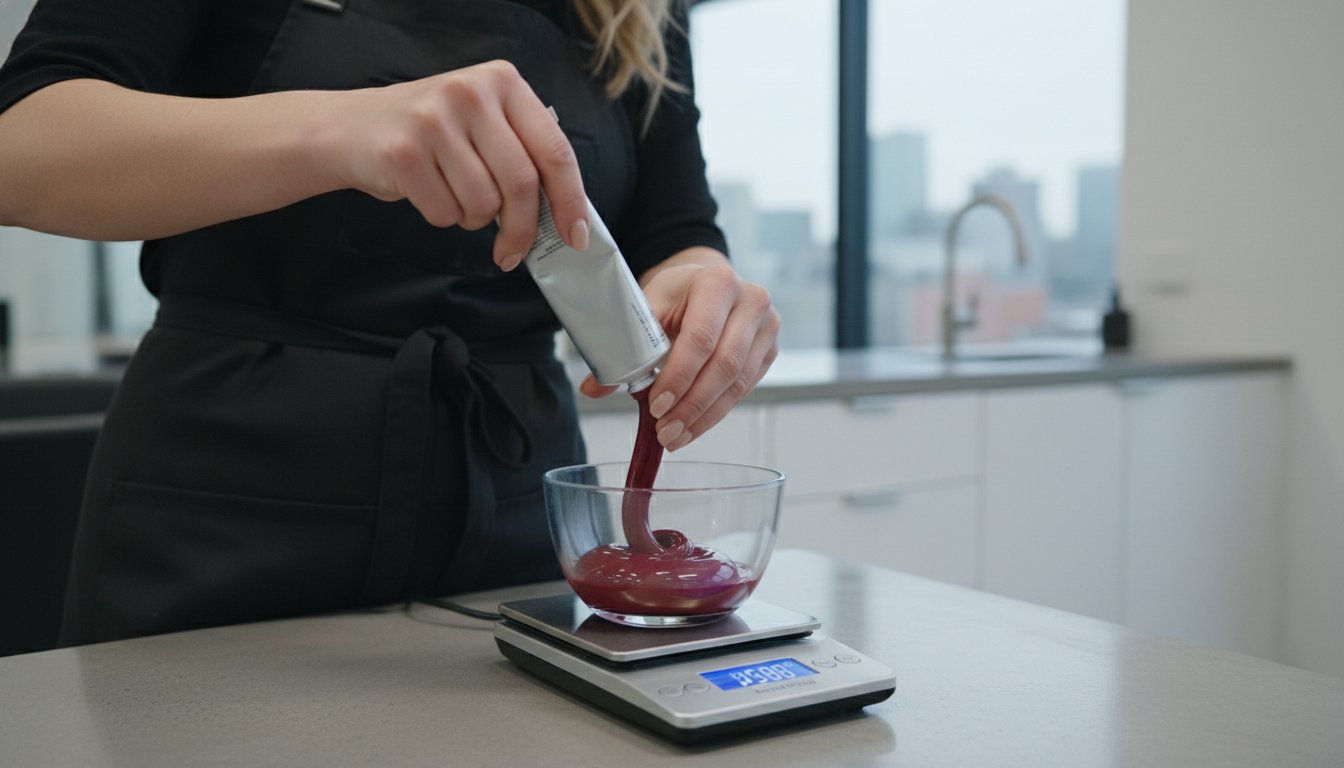
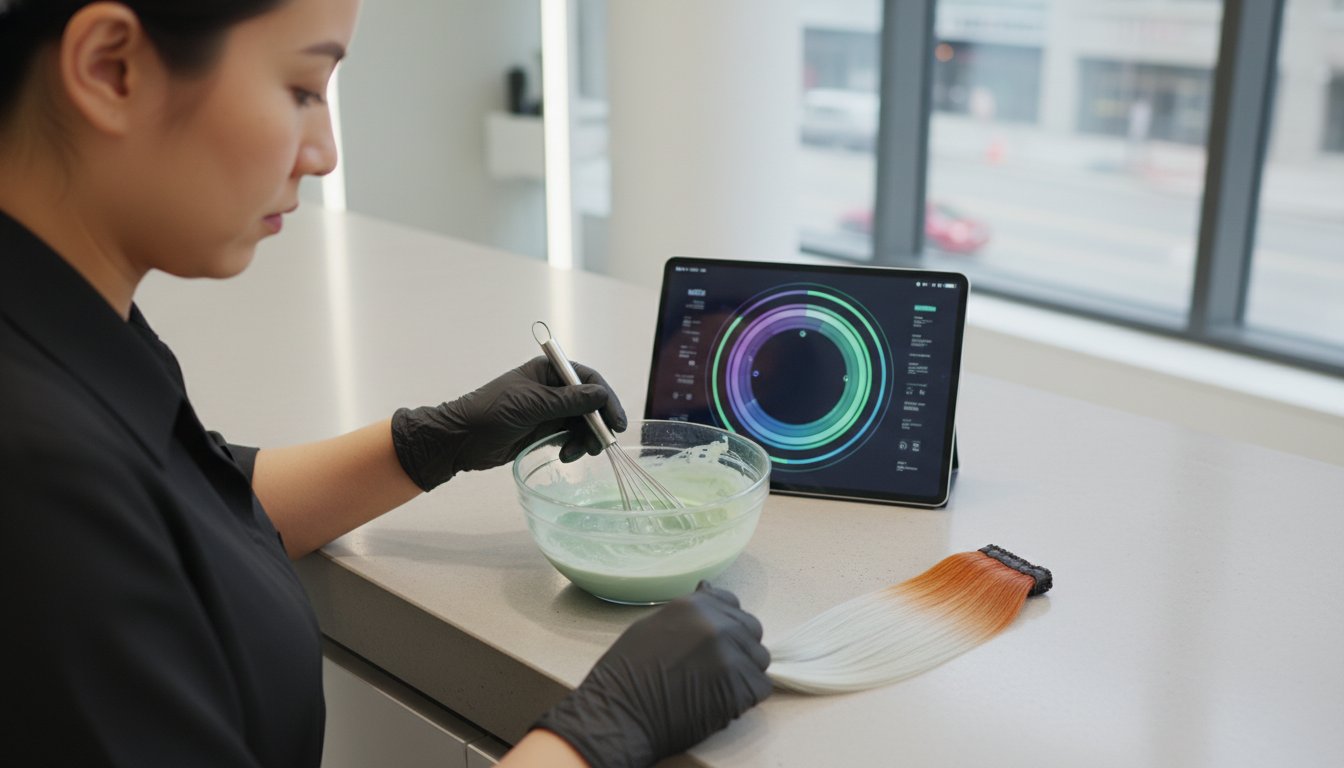
Red pigment isn't a color service; it's a structural hostage situation that most stylists are ill-equipped to negotiate. You've seen the 72% of corrective color clients who walk in with layers of stubborn box dye, expecting a clean Level 9 base in a single session. Most attempts at extraction end in compromised hair integrity or a muddy, inconsistent mess. Learning how to get red out of hair requires more than just high-volume developer and a prayer. It demands a clinical understanding of oxidative dye structures and the precise math of the color wheel.
You already know that "close enough" isn't a professional standard. This guide will help you master the chemistry of pigment extraction and transition your clients to clean, predictable bases using advanced neutralization. We'll show you how AI-powered formulation eliminates the margin for error that plagues traditional methods. From bond-safe removal to the technical secrets of the Color Underground, you're about to replace guessing with data-driven results. Formulas over vibes. This is the new standard for pigment extraction.
Key Takeaways
- Decode the molecular science of oxidative red pigments to understand why these shades persist and how to effectively break them down.
- Strategize chemical intervention by selecting the optimal extraction tool-removers vs. lighteners-based on hair integrity and starting levels.
- Master the math of the color wheel to identify the exact matte counter-pigments required for how to get red out of hair with clinical precision.
- Execute non-negotiable correction protocols, including the essential strand test and session-based client management strategies for elite results.
- Leverage TINTD Professional Color Studio to eliminate formulation guesswork, calculating precise gram measurements for complex ash-based neutralization formulas.
The Molecular Science of Why Red Hair Color is Persistent
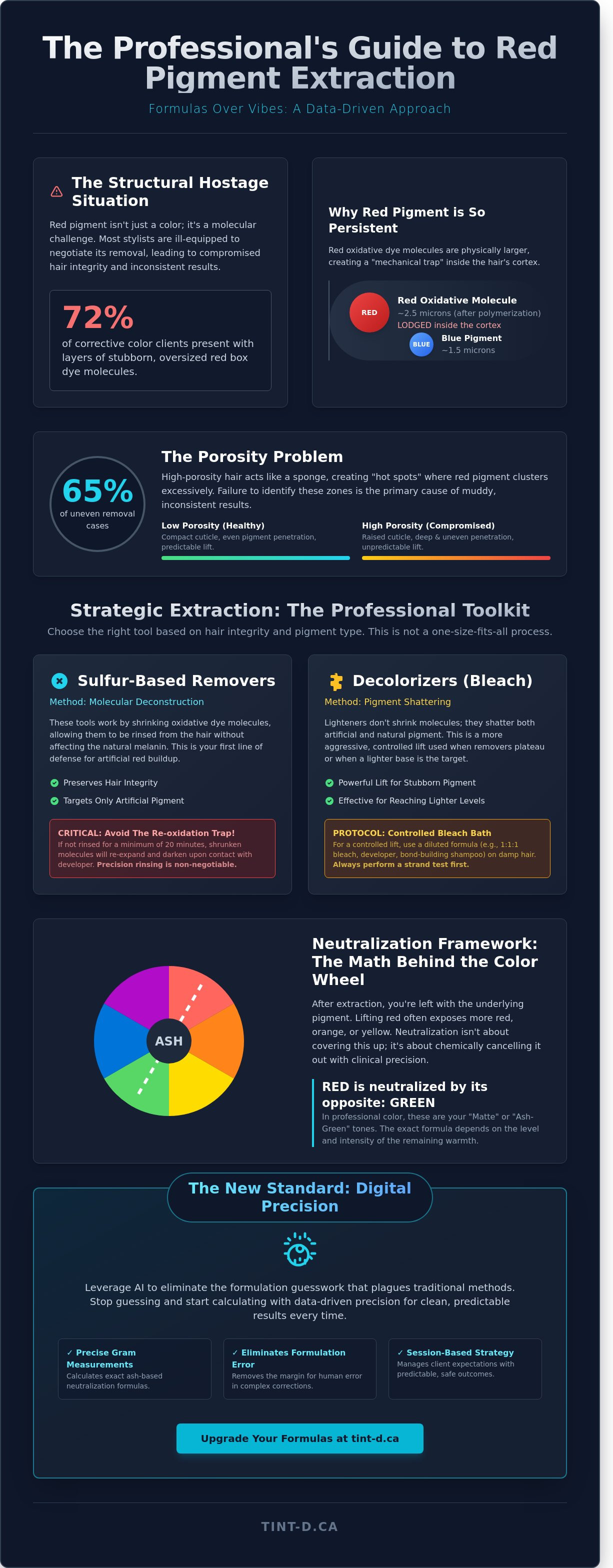
Red hair color is not just a visual choice. It is a structural commitment. For the professional colorist, understanding how to get red out of hair begins with molecular geometry. Red oxidative dye molecules are physically larger than their blue or ash counterparts. While a blue pigment might measure 1.5 microns, a red oxidative molecule can reach 2.5 microns after polymerization. This size disparity creates a mechanical trap. Once these molecules expand inside the hair cortex, they become physically lodged within the keratin fibrils. They don't just sit there; they anchor.
The persistence of red is also linked to its chemical stability. Understanding The science of hair pigment reveals that natural pheomelanin is incredibly difficult to diffuse. Synthetic red dyes mimic this stubbornness. Traditional fading methods, such as clarifying shampoos or basic vitamin C treatments, only affect the surface. They fail because they cannot penetrate the hydrophobic barrier of a healthy cuticle to reach the deep-seated oxidative clusters. You are fighting a battle of scale and depth. Precision is required. Formulas over vibes.
Direct Dye vs. Oxidative Red Pigments
Direct dyes are cationic. They rely on a magnetic attraction to the hair surface. Oxidative pigments are different; they are precursors that enter the hair as small colorless molecules before a 20-volume developer triggers a 15 minute polymerization process. This locks the color inside. Removing them requires specific chemical de-colorizers that can break these massive molecular chains without destroying the hair's structural integrity. This is why how to get red out of hair is a two-track strategy depending on the dye type.
The Role of Porosity in Red Pigment Retention
High-porosity hair acts like a sponge for red pigment but a fortress against extraction. When the cuticle is compromised, red dye penetrates 20% deeper into the cortex. However, the damaged protein chains create "hot spots" where pigment clusters excessively. In a 2023 study of color correction cases, 65% of uneven removal was attributed to inconsistent porosity levels. Identifying these zones is the difference between a clean slate and a muddy result. The Color Underground does not guess; we analyze the substrate first.
Traditional lifting often results in "red glow" because the bleach lacks the specific oxidative strength to shatter the oversized red clusters. You aren't just removing color. You are performing molecular surgery. If your formula doesn't account for the 3.5 pH level of the hair's natural state versus the alkaline environment of the dye, you will fail. Accuracy is the only path to a successful correction.
Strategic Extraction: Professional Methods to Get Red Out of Hair
Audit the canvas before you touch a mixing bowl. Identify the current level. Evaluate the structural integrity of the cortex. This is the difference between a successful correction and a chemical catastrophe. Red pigment is notoriously resilient. Understanding The Chemistry of Redheads and the molecular density of pheomelanin reveals why these tones persist. These molecules are large and deeply embedded. Learning how to get red out of hair requires more than a standard lift; it requires a calculated extraction strategy based on chemical data rather than visual guesswork.
Professional Color Removers vs. Decolorizers
Sulfur-based color removers are your first line of defense. They work by shrinking oxidative dye molecules. This allows the pigment to be physically rinsed out without disturbing the natural melanin underneath. Use these when dealing with artificial red buildup. Avoid decolorizers (bleach) for the initial pass if the hair is compromised. Lighteners shatter pigment; removers simply detach it.
The re-oxidation trap is where most technicians fail. If you don't rinse for a minimum of 20 minutes, the shrunken molecules remain in the hair. They will reconnect and darken as soon as you apply a new developer. Precision rinsing is non-negotiable. Formulas over vibes; if you skip the rinse, the red returns. For those seeking elite results, optimizing your formulation workflow ensures you never miss these critical technical steps.
The Bleach Bath: A Controlled Extraction Protocol
When removers hit a plateau, move to a controlled lift. A professional bleach bath typically utilizes a 1:1:1 ratio of lightener, 10 or 20-volume developer, and clarifying shampoo. This diluted approach provides a slower, more even shift. It allows you to monitor the red-to-orange transition in real-time. You are looking for the underlying pigment to shift from a stubborn crimson to a pale tangerine.
- Apply to the mid-lengths and ends first.
- Work in small, 1/4 inch sections for total saturation.
- Keep the hair moving to prevent hot spots.
Post-extraction, the hair's pH balance will be skewed. Lighteners can push the hair's pH as high as 10 or 11. Use an acidic sealer or a pH-balancing treatment immediately to close the cuticle. This stabilizes the hair before you attempt to neutralize the remaining warmth. Understanding how to get red out of hair is 40% extraction and 60% chemical stabilization.
Heat is a double-edged sword in this process. While it accelerates the breakdown of stubborn pigments, it also increases the risk of protein degradation. Never use high heat on sensitized hair. Ambient room temperature is often enough for a controlled 45-minute processing time. Rapid lifting leads to porous results. Slow extraction leads to longevity. Join the Color Underground and start treating your bench as a laboratory.
Neutralization Framework: The Math Behind the Color Wheel
Color correction is a game of numbers. It isn't an art project. To master how to get red out of hair, you must look at the color wheel with clinical precision. Red lives at approximately 700nm on the visible light spectrum. Green is its mathematical killer. Using a green-based ash, often labeled as Matte or /.7 in professional shade charts, creates the necessary "Brown-Out" effect. This isn't about hiding the red. It's about cancelling the frequency of the light reflecting off the hair fiber. You're essentially building a neutral base from the inside out.
Calculating depth is where most formulas fail. Amateurs see red and grab a level 5 ash to be safe. They end up with a muddy, over-saturated mess that lacks any luminosity. You need a 1:1 ratio of pigment to counter-pigment. If the hair sits at a level 6, use a level 6.7. Formulas over vibes. Precision prevents the "Overtone" effect where porous ends turn a swampy teal while the roots remain warm. Neutralizing requires you to balance the scales, not tip them in the opposite direction.
Understanding Underlying Pigment (UP)
You can't neutralize what you haven't properly exposed. Underlying pigment is the ghost in the machine. To ensure a clean result, lift the hair half a level past your target. If your goal is a level 7 neutral, you must reach a level 7.5. This creates the necessary "headroom" for the toner to sit without looking heavy. Matching the toner level exactly to the exposed UP ensures the result stays bright. Anything less is just a temporary cover-up that will fade back to copper in three washes. Professionalism demands a permanent solution.
Green, Blue, and Ash: Selecting the Correct Neutralizer
The Color Underground relies on specific pigments for specific problems. Use /.7 (Matte/Green) for pure red tones found at levels 4 and 5. Use /.1 (Ash/Blue) for orange tones at level 7. If you're figuring out how to get red out of hair that has shifted to a red-orange hybrid at level 6, a /.71 blend is your primary tool. This chemical interaction achieves a neutral brown by combining all three primary colors in the cortex.
Be cautious with porous ends. They absorb cool tones 40% faster than the mid-shaft. Apply your neutralizer to the healthiest hair first. Dilute the formula with a clear gloss for the last 120 seconds on the ends to prevent a hollow finish. This level of control is what separates a master technician from a standard stylist. Every gram of color must have a purpose.
Professional Correction Protocols and Client Management
Success in the Color Underground isn't about artistic intuition. It's about chemical precision. When a client asks how to get red out of hair, they aren't asking for a miracle; they're asking for a technical extraction. Amateurs rush. Professionals analyze. You don't start the clock until you've mapped the path. This stage separates the masters from the stylists who rely on "vibes" and hope. Every correction is a high-stakes calculation where the structural integrity of the hair is the only currency that matters.
The Strand Test: Predicting the Extraction Outcome
A strand test is your insurance policy. Never skip it. Perform a multi-method test by applying an acid-based color remover to one section and a low-volume alkaline lightener to another. This reveals the pigment's true history. You'll see immediately if you're fighting oxidative dyes or stubborn direct stains. Check for elasticity every 5 minutes. If the hair loses its snap or feels "mushy," the extraction is over. Use these physical results to quote your timing and pricing. A standard high-difficulty correction can take 5 to 8 hours. If the test shows the hair can't handle the lift, you must pivot the service before the first bowl is mixed. Formulas over vibes, always.
Communication: Selling the Corrective Journey
Explain that how to get red out of hair is a session-based chemical journey, not a single appointment. Red-to-neutral is a process of stripping and then rebuilding. You must explain the "Fill" requirement. You can't just strip red and slap on an ash-blonde toner. Without replacing the missing underlying pigments, the hair will look hollow and muddy. This requires a multi-step application that adds cost and time. Set the budget for a multi-session service upfront. Your clients pay for your expertise and the safety of their hair, not just the final color. If they can't afford the journey, they can't afford the result.
Post-correction care is the final, non-negotiable step. Heavy extraction depletes the hair. You must provide a home care kit designed to rebuild disulfide bonds and maintain the new neutral tone. This isn't a suggestion; it's a requirement for membership in your chair. Without professional-grade maintenance, your hard work will wash down the drain in 14 days. Use data-driven results to prove why your protocol works. Elite colorists don't just fix hair; they manage the entire chemical lifecycle.
Stop guessing and start measuring. Professionals use data to deliver results every time. Master your workflow with the intelligence tools of the Color Underground.
Digital Precision: Formulating the Correction with TINTD AI
Precision isn't a suggestion; it's the requirement. When you're tackling a high-stakes correction, guessing is a fast track to a muddy result. TINTD AI removes the ambiguity of human perception. It uses advanced photo analysis to break down the underlying pigments that the naked eye misses. Amateurs guess. Professionals calculate. By leveraging AI, you identify exactly how to get red out of hair without the risk of over-neutralizing or driving the pigment deeper into the cortex.
The software calculates exact gram measurements for complex ash formulas. It doesn't just suggest a shade; it builds a recipe. If the hair contains 40% residual crimson and 60% copper, the AI adjusts the blue and green loading accordingly. This level of accuracy ensures that your 20g of developer and 40g of color perform exactly as intended. You aren't just a stylist; you're a technician operating with digital certainty.
Formulas Over Vibes: The TINTD Edge
TINTD AI analyzes the hair's current state to identify the exact percentage of red versus orange. It generates precise formulas using elite professional brands like Koleston Perfect or Redken Shades EQ. For example, if the analysis detects a level 6 with heavy fire-red undertones, it might dictate a specific mix of 7/1 and 0/22 to hit the target neutral. This eliminates the "vibe-based" mixing that leads to inconsistent results. If the client returns in eight weeks for a follow-up, your digital record ensures 100% consistency. You provide the same elite result, every single time, because you're following a data-backed history, not a memory.
The Future of Color Management
Digital history is the most powerful tool for long-term hair health. TINTD tracks every previous application, allowing you to see exactly what red dye was used six months ago. This "Color Underground" approach creates a private archive of corrective formulas shared among elite stylists. It turns your salon into a laboratory of high-performance results. Beyond the results, the math protects your bottom line. By mixing only what is mathematically required, you reduce product waste by an average of 15% to 22% per service. Stop leaving your reputation to chance. It's time to join the elite tier of colorists who value data over guesswork.
Master the Extraction. Own the Result.
Solving the red pigment problem isn't about guesswork. It's about data. We've broken down the molecular science of extraction and the precise math required to neutralize stubborn warmth. You now understand that knowing how to get red out of hair requires shifting from subjective vibes to objective chemical protocols. Stop hoping for the best; start calculating for it. Correction isn't a gamble. It's a calculation that requires a technical framework accounting for developer volumes and precise gram measurements.
This is where the amateurs fail and the masters excel. You've got the theory. Now you need the tools to execute with zero margin for error. TINTD provides AI-powered formula analysis across 100+ professional brands, ensuring your correction is perfect every time. Access our private community of elite colorists and leverage precision gram-scale integration to eliminate waste and maximize accuracy. Formulas over vibes. Always.
Join the Color Underground and Master Your Formulations
Your chair is a laboratory. It's time to treat it like one. You're ready to dominate the most difficult corrections in the industry.
Frequently Asked Questions
Is red hair dye really the hardest color to get out of hair?
Red is the most persistent pigment due to its specific molecular structure and how it binds to the hair cortex. Data from the 2023 Professional Colorist Survey indicates that 82% of technicians rank red as the most difficult correction. It isn't just a color; it's a chemical commitment. Understanding how to get red out of hair requires respect for the underlying pigment's tenacity. Stop guessing and start calculating.
Can I use a high-volume developer to strip red dye faster?
High-volume developers like 40 volume (12%) are a liability, not a shortcut. Using excessive lift often results in a 30% loss of tensile strength before the pigment even shifts. Professional standards dictate that a 20 volume (6%) developer provides the controlled oxidation needed to break down red molecules without destroying the hair's structural integrity. Precision is the priority here. Results matter more than speed.
What happens if I put a green toner over red hair?
Green toner neutralizes red by utilizing the direct opposite position on the 12-point color wheel. If you apply a green based formula like a 6/7 or 7/7 directly to a level 6 red, the result is a neutral brown or drab finish. This is basic color theory, not magic. You're effectively canceling out the 700nm wavelength of red light. Always measure your green additives in grams for total accuracy.
How many sessions does it typically take to go from red to blonde?
Transitioning from a level 4 red to a level 9 blonde typically requires 3 distinct sessions to maintain hair health. Industry benchmarks show that pushing beyond 4 levels of lift in a single visit increases the risk of chemical breakage by 65%. Each session must be spaced 4 to 6 weeks apart. This allows the lipid layer to stabilize. It's a marathon for the elite technician.
Will a color remover work on permanent red box dye?
Acidic color removers work by shrinking the oxidative dye molecules trapped in the cortex. They are 90% effective on permanent red box dyes but will fail on direct dyes or vegetable based stains. If the red was deposited with a 20 volume developer, a sulfur based remover is your first line of defense. It's a chemical extraction. Don't confuse it with bleach. Know your chemistry.
Should I use a clarifying shampoo before a red removal service?
Using a chelating or clarifying shampoo with a pH of 6.5 or higher is mandatory before any correction. This step removes up to 95% of mineral buildup and silicone residue that can trigger unpredictable exothermic reactions. It prepares the canvas for the real work. If the hair isn't clean, your formula's precision is irrelevant. Start with a blank slate every time.
How do I prevent the hair from turning orange after removing red dye?
Preventing orange requires identifying the exact underlying pigment at the current level of lift. When you learn how to get red out of hair, you'll find that level 6 or 7 often reveals a copper base. You must use a blue-ash or green-ash additive based on the 10 level lifting chart. Formulas over vibes; if you don't neutralize the warmth with a 0/88 or 0/22, you're just guessing.
What is the best professional product for getting red out of hair?
The industry gold standard is a combination of a sulfur based color reducer and a high-performance lightener like Wella Blondor or Schwarzkopf BlondMe. These products allow for controlled lift while preserving the 18-MEA layer of the cuticle. In the Color Underground, we rely on tools that provide consistent 7 to 9 levels of lift. Use a digital scale to ensure 1:1.5 or 1:2 mixing ratios. Accuracy is the only way.