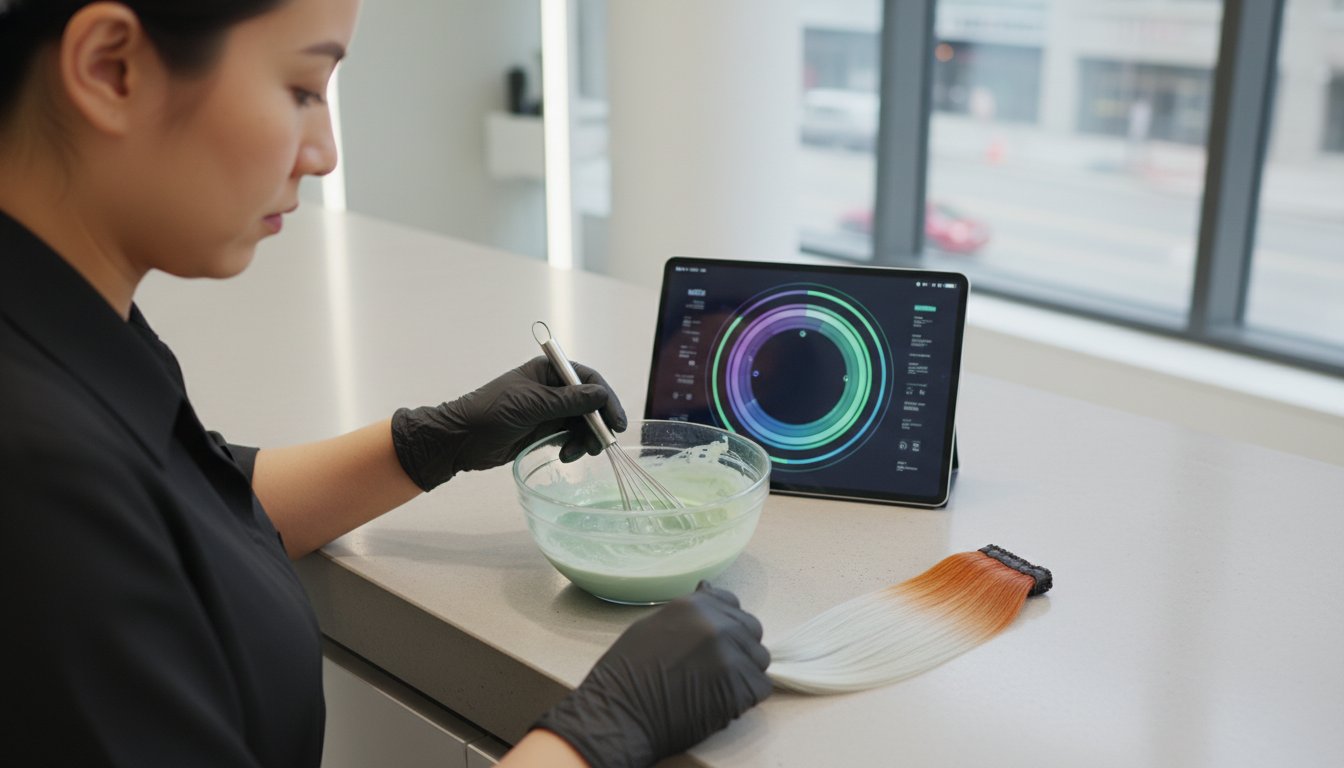
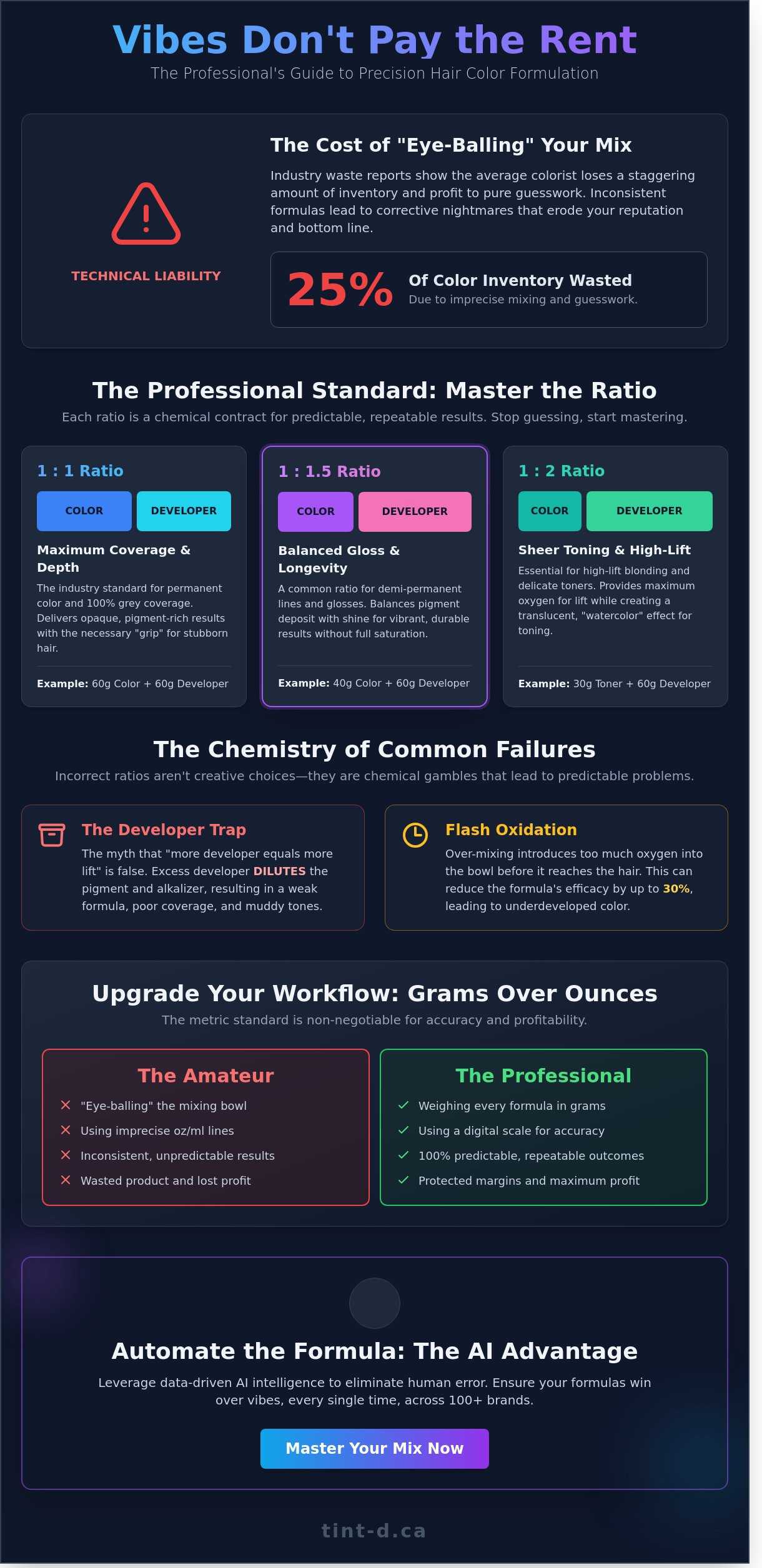
Vibes don't pay the rent. In a high-performance salon, "eye-balling" your mixing bowl is a technical liability that costs the average colorist 25% of their inventory through pure waste, according to 2023 industry waste reports. If you're still wondering exactly how much hair color and developer to use based on intuition rather than data, you're running an amateur operation. Precision is the only path to 100% predictable results. You know that inconsistent lifts and muddy tones aren't just technical failures; they're expensive corrective nightmares that erode your reputation and your bottom line.
This article promises to strip away the industry fluff and master the precise chemistry of professional ratios. We're moving past the "glug-glug" method to implement a clinical, gram-based workflow that protects your service margins. We will analyze specific developer volumes, the chemical necessity of 1:1 versus 1:2 ratios, and the technical math required to eliminate backbar drain. Welcome to the Color Underground, where we trade guesswork for the rigorous science of the perfect formula.
Key Takeaways
- Stop guessing. Master the precise 1:1 and 1:2 ratios that separate professional technicians from amateurs.
- Protect your margins. Identify the "Margin Gap" where minor measurement errors translate into thousands in lost annual revenue.
- Adopt the metric standard. Learn why measuring in grams is the non-negotiable requirement for complex, multi-tonal accuracy.
- Master how much hair color and developer to mix for perfect cortical saturation while eliminating technical failures like hot roots.
- Leverage AI intelligence. Use data-driven tools to automate ratios across 100+ brands and ensure formulas always win over vibes.
The Professional Standard: Decoding Color-to-Developer Ratios
Precision is the price of admission in high-stakes hair coloring. Guessing is for the uninitiated. In the Color Underground, we rely on data, not intuition. Professionals understand that determining how much hair color and developer to use isn't a creative choice; it's a chemical calculation. Every tube of color is engineered to interact with a specific volume of oxygen. When you ignore these ratios, you aren't being an artist. You're being reckless with your client's hair integrity and your own profit margins.
The manufacturer’s instructions represent a chemical contract. This contract ensures that the alkalinity of the color cream is perfectly balanced by the acidity and oxidative potential of the developer. To ignore this is to invite disaster. To master the craft, you must master the three pillars of professional mixing: the 1:1, 1:1.5, and 1:2 ratios. Understanding The Chemistry of Hair Color is essential for any technician who wants to move beyond basic application into true technical mastery. This knowledge prevents the 15% product waste seen in salons that still rely on "eyeballing" their mixtures.
The 1:1 Ratio: Maximum Coverage and Depth
The 1:1 ratio is the industry standard for permanent color and total grey coverage. It delivers an opaque, pigment-rich result. By mixing equal parts color and developer, you ensure there's enough alkalinity to open the cuticle and enough peroxide to develop every dye molecule. This ratio is the backbone of brands like Wella Koleston Perfect. Use it when 100% saturation is the goal. It provides the necessary "grip" for stubborn, non-pigmented hair. If you're working with a level 6/0 for a root retouch, 60g of color requires exactly 60g of developer. No more, no less.
The 1:2 Ratio: Sheer Toning and High-Lift
When the goal shifts from coverage to transformation, the ratio shifts to 1:2. This is the domain of high-lift series and sheer toners. High-lift colors require double the developer volume to provide the oxygen needed to blast through natural pigment while simultaneously depositing tone. In toning scenarios, the 1:2 ratio manages the pH shift. It allows for a more translucent, "watercolor" effect that neutralizes underlying brassiness without over-depositing dark pigments. Calculating how much hair color and developer for a toner usually means 30g of shade mixed with 60g of a low-volume processing solution. This ensures the cuticle isn't unnecessarily blown open, preserving the hair's natural shine and structural health.
- 1:1 Ratio: Best for grey coverage and permanent depth.
- 1:1.5 Ratio: Often used for demi-permanent glosses to balance longevity with shine.
- 1:2 Ratio: Essential for high-lift blonding and delicate toning.
Formulas over vibes. That's the mantra. Stop guessing. Start weighing. Your consistency depends on it.
The Chemistry of the Mix: Saturation vs. Dilution
Precision measurement isn't a suggestion; it's the foundation of the Color Underground. When you guess how much hair color and developer to use, you're gambling with the hair's integrity. Incorrect ratios trigger specific failures. Too much developer creates "hot roots" by over-accelerating the lift near the scalp's heat. Too little results in "muddy ends" where pigment lacks the oxidative strength to develop fully. Hydrogen peroxide acts as the catalyst in this complex chemical reaction, driving oxygen into the cortex to dissolve melanin and lock in new tones. If the concentration is off by even 5 grams, the saturation fails, leaving the hair under-processed or chemically scorched.
The "developer trap" is a common professional pitfall. Many colorists assume more developer equals more lift. It doesn't. Excessive developer dilutes the alkalizer and the pigment load. You end up with a weak formula that lacks the punch to shift the natural level or the density to cover gray. It's about chemical balance, not volume. Stop relying on "vibes" and start respecting the stoichiometry of the bowl. For those ready to leave the guesswork behind, using an AI-powered formulation tool ensures your ratios are locked for performance, not just habit.
Over-Mixing and Oxidation
Speed matters. The moment color meets developer, the clock starts. Over-mixing introduces excessive oxygen into the bowl before the product even touches the hair. This "Flash Oxidation" can reduce the formula's efficacy by 30% within the first 15 minutes. TINTD AI accounts for this by calculating "working time" into its logic. It ensures the how much hair color and developer equation matches your actual application speed. If you take 40 minutes to apply a full head, your bowl shouldn't be oxidizing at minute 10.
The pH Factor in Developer Selection
Developer choice dictates the cuticle's fate. 10 volume is mildly acidic, designed for deposit. 20 volume provides the standard 1 to 2 levels of lift. 30 and 40 volumes are highly alkaline, aggressively swelling the cuticle to reach the deep cortex. When porosity is compromised, these standard rules break. High-porosity hair absorbs liquid too fast, requiring a lower developer ratio to prevent "grabbing" too dark. pH-balanced formulation is a requirement for cuticle longevity. Professionals use 1:1 ratios for maximum opacity and 1:2 for high-lift transparency, but these must be adjusted based on the hair's structural health.
Solving the Margin Gap: Why Precision Equals Profit
The Margin Gap is the silent killer of salon profitability. It represents the delta between the product you bill for and the product that actually leaves your backbar. Most stylists treat color like an art project. They eyeball the bowl. They guess the viscosity. This lack of rigor creates a financial leak that most owners ignore until the end of the quarter. When you fail to track exactly how much hair color and developer is used in every bowl, you aren't just wasting product. You're eroding your take-home pay.
Precision is the only defense against "product bleed." Industry data indicates that wasting just 5 grams of color per client costs a mid-sized salon thousands of dollars annually. This isn't a hypothetical risk. It's a mathematical certainty. Beyond the immediate waste, inconsistent mixing creates a hidden tax: the corrective color service. A formula mixed at a 1:1.2 ratio instead of the required 1:1.5 results in unpredictable lift or unwanted banding. A correction takes three to four hours of chair time. That's a double loss of inventory and opportunity cost.
Calculating the Cost Per Gram
Stop thinking in tubes. Start thinking in milligrams. A tube is a variable unit that changes based on brand and density. Milligrams are absolute. Professional scales are non-negotiable for anyone who takes their craft seriously. You cannot manage what you do not measure. By breaking down your service pricing to the milligram, you shift the culture of your salon from "guessing" to "knowing." This psychological shift ensures that every drop of 6.0 or 20-volume developer is accounted for in your profit margins.
Reducing Waste Through Digital Accuracy
Data is the antidote to the "vibes-based" backbar. Case studies across high-performance salons show that implementing digital tracking reduces color waste by 20% to 30%. This level of accuracy does more than save money. It builds a bridge to predictable retail sales. When a client sees the technical mastery involved in your mixing process, they trust the science of your recommendations.
- Eliminate the Guesswork: Digital logs record the exact how much hair color and developer was used for every Koleston Perfect or Igora Royal formula.
- Inventory Intelligence: Real-time tracking prevents over-ordering and ensures you never run out of 7/1 during a busy Saturday.
- Team Accountability: Data moves your staff away from subjective mixing and toward a standardized, professional workflow.
Transitioning your team to a data-driven approach is the price of admission for The Color Underground. It separates the hobbyists from the technicians. Precision isn't just about being careful. It's about protecting the integrity of your business and the consistency of your results. Formulas over vibes. Every single time.
Grams Over Ounces: The Modern Stylist’s Toolset
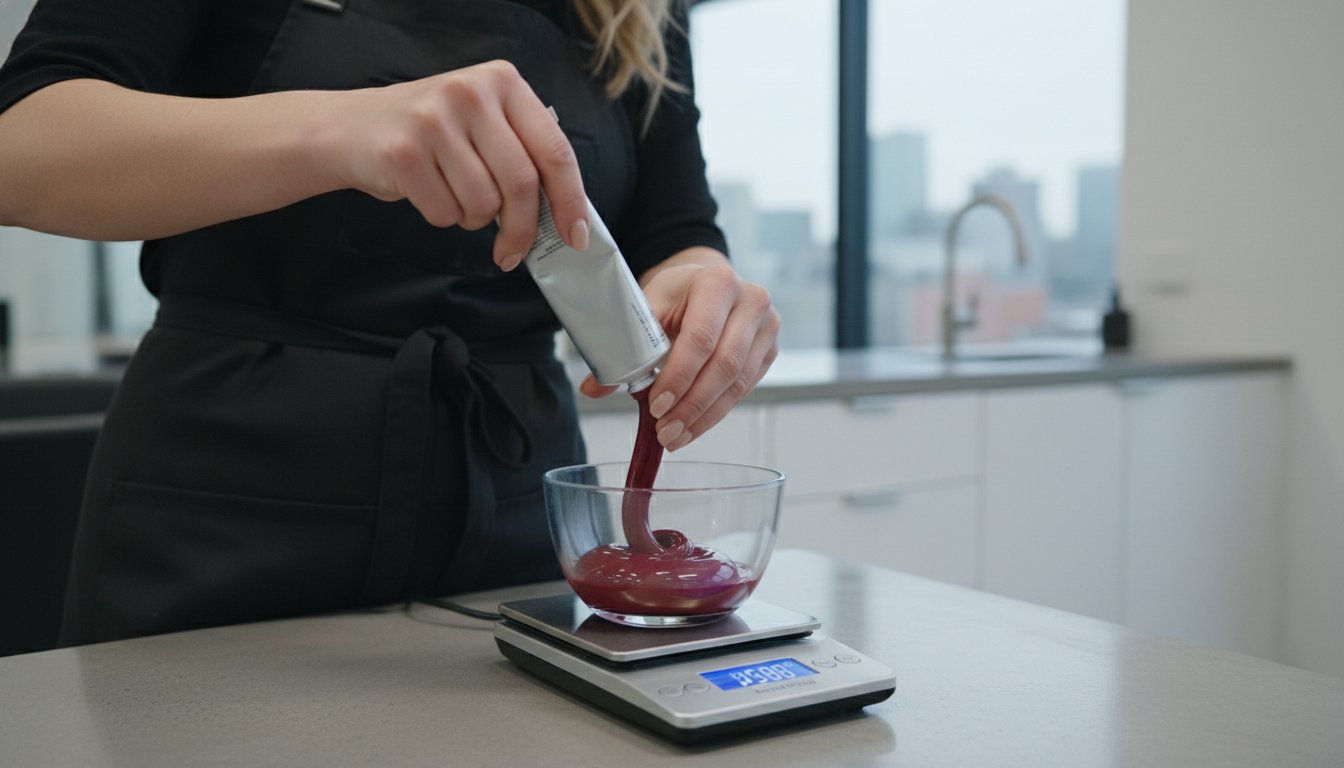
Precision isn't optional. The Color Underground speaks the metric system because grams don't lie. Ounces are too broad; they leave a margin for error that destroys your profit margins. Measuring by "parts" is a relic of the past. While a 1:1.5 ratio looks simple on paper, a 5% deviation in your pour during a 60g application creates an inconsistent result. If you are still eyeballing the lines on a plastic beaker to determine how much hair color and developer to use, you are practicing vibes, not chemistry.
Setting up a digital color bar requires a scale accurate to 0.1 grams. Standard kitchen scales won't cut it. Your tools require weekly calibration. A scale that is off by even 1.5 grams will ruin a delicate toner formula. Test your equipment every Monday morning with a standard 100g calibration weight. If the numbers don't match, your formulas won't either. Professionalism starts with hardware that works.
The Digital Scale Workflow
Efficiency is the byproduct of a repeatable system. Every bowl follows a three-step protocol: tare, pour, and record. This eliminates the mental gymnastics of subtracting bowl weight from your total. The scale provides the raw data, ensuring your 1:1 ratio is actually 1:1. This level of accuracy is vital for "micro-dosing" corrective toners. When a formula requires 0.3g of a violet intensifier to neutralize a stubborn gold band, you cannot see that volume in a measuring cup. You can only weigh it. Integrating your scale with TINTD allows for real-time formula logging, turning every gram poured into a permanent data point in your cloud-based lab.
Formula History and Client Profiles
"The usual" is not a formula; it is a guess. Hair is a dynamic canvas that reacts to the environment. A professional colorist tracks seasonal shifts with clinical detail. In July, high UV exposure and chlorine might require dropping from a 20 volume developer to a 10 volume to protect sensitized ends. In January, low humidity changes how the hair absorbs pigment. A digital "color bible" replaces the messy index cards of the 90s. It allows you to see exactly how much hair color and developer was used during the last three appointments. You can identify patterns, predict product depletion, and ensure that every client receives the exact same shade of 7/3 + 7/0, regardless of the season.
Stop relying on memory and start relying on data. Build your digital color bible with TINTD’s precision logging tools.
Automating the Formula: The TINTD AI Advantage
Precision isn't a luxury in this industry. It's the baseline for survival. TINTD eliminates the margin gap by processing data from 100+ professional color brands to calculate the perfect ratio every time. We've removed the room for human error in complex, multi-shade formulations. This isn't a digital notepad; it's a high-performance engine for your salon. By leveraging advanced photo analysis, the AI determines starting levels and porosity with a level of accuracy the human eye simply cannot match. You get a clinical assessment before the first gram hits the bowl.
Formulas Over Vibes
Art thrives when the math is settled. TINTD manages the technical logic so you can focus on the creative execution. Imagine you're formulating for a Level 6 Copper on a client with 20% grey. Traditional guesswork often leads to hot roots or hollow ends. TINTD acts as your AI co-pilot for these high-stakes corrections. It calculates exactly how much hair color and developer is needed based on the specific chemistry of the brand you're using. If you're mixing Koleston Perfect 7/3 with 7/0, the AI ensures the balance is perfect for the hair's current state. It replaces "vibes" with data-driven certainty.
The system doesn't just suggest; it validates. It looks at the resistance of the hair and the desired lift. It then generates a precise measurement list in grams. This prevents the wasteful habit of over-mixing. You save product. You save time. You save your reputation. The software understands the "way you actually work" because it was built for the floor, not the office.
Enterprise Efficiency for Salons
Consistency is the only way to scale. TINTD allows owners to standardize results across 10+ stations instantly. You can't rely on every stylist having the same "eye," but you can ensure they use the same intelligence. Onboarding new talent becomes a streamlined process using TINTD’s extensive brand library. They don't need to guess the manufacturer's intent; the software already knows it. This is how elite salons protect their margins and their clients. You aren't just mixing color; you're running a laboratory.
The Color Underground is moving away from the old ways of estimation. Elite stylists are choosing digital mastery over analog mistakes. Knowing exactly how much hair color and developer to use is the difference between a profitable service and a wasted afternoon. Stop leaving your revenue to chance. Ready to stop guessing? Join the TINTD Professional Plan today.
Take Command of Your Backbar
Professional coloring is a game of milligrams. Precision isn't optional; it's the line between a predictable result and a costly mistake. You've seen why the industry is moving away from fluid ounces toward the exactitude of grams. You understand that the chemistry of saturation dictates the longevity of your work. Most importantly, you know that guessing how much hair color and developer to mix is the fastest way to erode your profits and your reputation.
TINTD replaces guesswork with clinical accuracy. Our platform leverages AI analysis of 100+ professional color brands to ensure your ratios are perfect every time. Elite stylists in Montreal and across North America use TINTD to reduce backbar waste by up to 30%. We don't do fluff. We do formulas. It's time to stop letting vibes dictate your mix and start using the intelligence your craft deserves. Join the elite who prioritize data over hope.
Join the Color Underground: Get TINTD Professional
Your mastery starts at the scale.
Frequently Asked Questions
What happens if I use too much developer in my hair color mix?
Excess developer dilutes the pigment load and weakens the final deposit. This imbalance increases the pH level beyond the intended range, often resulting in a 15% loss of pigment density. You'll see "hot roots" or a lack of depth because the formula becomes too translucent to cover the hair effectively. Precision is mandatory; guessing leads to inconsistent results that compromise the hair's structural integrity.
Can I mix different brands of hair color and developer?
Never mix brands because manufacturers engineer their systems to operate at specific pH levels, typically between 9.0 and 11.0. Using a Wella developer with a Schwarzkopf color disrupts the intended chemical chain reaction. This creates unpredictable oxidation and can lead to scalp irritation or uneven tones. It's an amateur move that voids all technical accountability. Stick to the system for professional results.
Does the ratio change when I am using a 20-volume vs a 40-volume developer?
The mixing ratio remains constant regardless of the developer volume unless you're using a specific high-lift series. A 1:1 ratio stays 1:1 whether you use 20-volume or 40-volume because the ratio dictates pigment concentration while the volume controls the lift. Always consult the manufacturer's technical manual for the 100% accurate specification. Follow the data provided by the brand, not a feeling or a hunch.
How much developer do I need for a 2 oz (60ml) tube of color?
For a standard 1:1 ratio, you need exactly 2 oz (60ml) of developer to match the color. If your specific formula requires a 1:2 ratio, you'll need 4 oz (120ml). Calculating how much hair color and developer is required depends entirely on the manufacturer's mixing instructions for that specific line. Use a digital scale to ensure you're within a 0.1g margin of error for every application.
What is the best way to measure hair color and developer for accuracy?
Use a digital scale calibrated to grams for every formula. Volumetric measuring in beakers or cups is 12% less accurate because product clings to the sides of the container. Grams provide a precise, repeatable data point that ensures your results are identical every time. You can't replicate a formula you didn't measure correctly. Professionals weigh everything because vibes don't mix color; data does.
Why does my hair color look translucent or "watered down"?
Translucency is a direct symptom of over-dilution from using too much developer. If your 1:1 formula looks like a glaze, you've likely exceeded the developer requirement by as little as 10ml. This creates a "watered down" effect where the pigment load can't bridge the gap between the hair's natural level and the target shade. It's a failure of measurement that requires a corrected ratio to restore opacity.
How do I calculate the ratio for a three-shade custom formula?
Combine the total weight of all three shades first to determine your developer requirement. If you mix 20g of 7/0, 10g of 7/3, and 5g of 0/33, your total color weight is 35g. For a 1:1 ratio, you'll add exactly 35g of developer to the bowl. The number of shades in your formula doesn't change the foundational math. Map your formula on TINTD to eliminate any margin of error.
Is a 1:1.5 ratio better for grey coverage than a 1:1 ratio?
A 1:1 ratio is superior for 100% grey coverage because it provides the maximum pigment density. A 1:1.5 ratio increases the developer proportion, which provides more lift but results in a more sheer deposit. This often leaves stubborn white hair under-pigmented or translucent. Data shows that a 1:1 mix provides the opacity required to mask non-pigmented hair fibers. Choose density over spreadability for every grey service.